Custom Reed Diffuser Boxes: Packaging That Brings Product and Brand Together
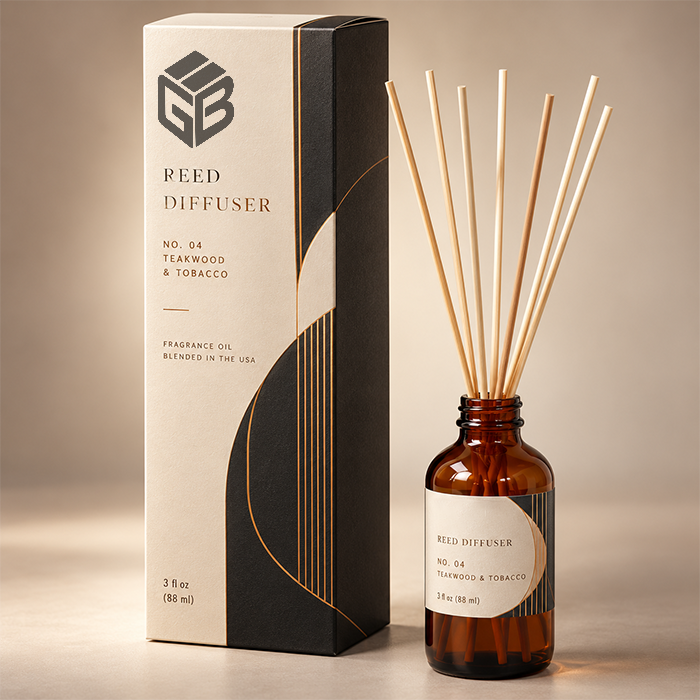
A reed diffuser package needs to accommodate several elements: the vessel, its closure, the reeds, and any accompanying instructions. The design should give each component a suitable place while presenting the product clearly. Custom reed diffuser boxes bring these practical needs together with a brand’s colors, artwork, and identity.
The starting point is fit. Before choosing decorative finishes, establish the dimensions of the complete product and how it will be packed. A considered box should feel appropriate to its contents, open comfortably, and communicate the information the customer needs.
Begin With the Complete Product
Measure every component that will go inside the box. Include the filled vessel in its final closed condition, the reeds, any protective packaging, and additional cards or accessories.
Decide whether the reeds will sit beside the vessel, occupy a separate section, or use another arrangement. Their position should be planned rather than treated as leftover space.
A useful packaging brief should cover:
The vessel’s dimensions and packed weight
The length and quantity of the reeds
The closure and any primary protective packaging
The number of items included
Instructions and labeling requirements
The intended packing and delivery process
These details provide a clear foundation for structural design.
Choose Dimensions Around the Actual Contents
Confirm whether proposed measurements refer to the internal or external dimensions of the finished box. Account for inserts, dividers, and other components that occupy space.
The vessel should fit without forcing the panels outward or placing pressure on its closure. The reeds should also sit comfortably without being bent to accommodate an unsuitable box size.
Leave enough access for the customer to remove each component naturally. A tightly fitted presentation is not useful if the recipient has to pull awkwardly on the contents.
Review the dimensions using a physical sample and the actual product.
Select a Structure With a Clear Purpose
Choose the box format according to the product, packing workflow, and intended presentation. A folding carton, separate lid-and-base box, or sliding arrangement offers a different opening sequence.
Check how the box is assembled and how the customer will reach the contents. Additional layers should support the arrangement or serve a defined design purpose.
Do not choose a larger or more elaborate structure solely to create an impression of value. The packaging should remain proportionate to the product.
Assess the proposed construction as a complete packed unit rather than approving an empty sample.
Give the Vessel and Reeds Defined Positions
An interior arrangement should keep the components organized while allowing straightforward removal. Decide whether a divider, fitted insert, or another support is appropriate.
Check that the vessel can be lifted without pulling on the closure. Make sure the reeds are accessible and do not obscure information or interfere with the opening action.
Review the package after one component has been removed as well as when it is full. The remaining items should still be easy to reach.
Avoid adding decorative filler without a clear reason. A simple, well-planned arrangement can provide a more coherent presentation than several unrelated layers.
Build a Clear Information Hierarchy
The packaging should make the product and its variant easy to identify. Establish a clear relationship between the brand name, fragrance name, quantity information, and supporting details.
Reserve space for instructions and any warnings required for the specific formulation and market. Have that content reviewed by an appropriately qualified person before finalizing the artwork.
Keep important information readable rather than reducing it to preserve decorative space. The outer box and product label should also remain consistent.
If a separate instruction card is included, decide what information still needs to appear elsewhere on the package.
Connect the Artwork to the Brand
Use the business’s established colors, typography, and visual style as the starting point. The box should feel connected to the vessel label and other product materials.
A restrained design might focus on a logo and fragrance name. A more expressive approach could use illustration or a pattern, provided the information remains clear.
For a collection of fragrances, decide which elements stay consistent and which distinguish each variant. Include written names rather than relying on color alone.
Review the artwork on the assembled box. Folds, edges, and panel orientation can change how a flat design appears.
Use Descriptive Language Carefully
Product descriptions should reflect the actual fragrance and intended use. Avoid turning a scent description into an unsupported claim about health, safety, or therapeutic effects.
Likewise, words such as “natural,” “non-toxic,” or “eco-friendly” should not be added simply because they suit the visual identity. Any claim needs a clear basis relevant to the product or finished packaging.
Keep decorative language separate from practical instructions. Customers should be able to identify how to use and handle the product without searching through promotional copy.
Clear wording is more useful than an impression the product cannot substantiate.
Review Materials and Finishes Together
Ask the supplier to specify the box material, printing, coatings, inserts, and any additional components. Review the complete construction rather than one visible surface.
Choose finishing details selectively. A textured surface, subtle raised mark, or limited metallic accent may suit the design without requiring several competing treatments.
Request representative samples and inspect the corners, folds, printed details, and opening action. Check the package under ordinary lighting as well as in presentation photographs.
Environmental statements should relate to the finished packaging and be supported by appropriate information.
Assess the Delivery Arrangement Separately
A retail box should not automatically be treated as a complete shipping solution. Review the packed product, primary container, and outer delivery packaging together.
Confirm what assessment is appropriate for the actual formulation, vessel, route, and delivery method. Check applicable carrier requirements rather than assuming that every reed diffuser can follow the same process.
Include the final product configuration in any packing trial. Changes to the vessel, closure, insert, or box may require the arrangement to be reviewed again.
Keep the approved specification available for repeat orders.
Test Packing Before Approving Production
Ask the team responsible for fulfillment to assemble and pack sample boxes using the normal workflow. Include all labels, reeds, instructions, and accessories.
Look for awkward folds, difficult insert placement, unclear orientation, or steps that require repeated adjustment. Check how staff will distinguish similar-looking fragrance variants.
Before final approval, review the physical sample alongside the artwork proof. Confirm dimensions, product names, quantities, spelling, warning placement, and panel alignment.

About Premium Author
This post has been authored and published by one of our premium contributors, who are experts in their fields. They bring high-quality, well-researched content that adds significant value to our platform.
You Might Also Like

Popular Categories
Stay Connected
Recent Posts